
Many thanks to Solomon G for permitting my guest post! – Aborigen
For this essay I’m going to refer to the giant woman/tiny man aspect of Size Fantasy due to the specific accusation that (necessarily male) Size fetishists lust after their mothers. It’s absolutely a fact that tiny women can be attracted to giant men, there are loving, sensual relationships between giant and tiny men and giant and tiny women, etc. The limitation in scope here is intended to focus on one narrow issue.
Polysemiotics means that any image or signal can mean different things to different people, depending both on the context in which it appears and the background and intention of the interpreter. For example, visualize a mug lying on its side on a table. Picture the mug, picture the table, visualize what may have been in the mug, the lighting in the room.
Was it knocked over by a cat or an angry person? Was it dropped by a victim of poisoning? Is it simply an artsy still-life arrangement? It is impossible to empirically say what caused it and what it means without having witnessed its creation. A lot of forensic work is required of the viewer to bring meaning to it, and it’s now an interactive piece where every viewer brings something different and valid to its interpretation.
No less fraught with meaning and interpretation is the world of pornography. If you see a naked woman bending over and exposing herself, we have no way of knowing whether she’s making an invitation to the viewer or is being paid or forced to present herself. We can’t know whether she’s an exhibitionist or if she’s the main course for a train of fuckbois. This ambiguity lends itself to great creative latitude for producers (and pirates). Some cheap, bottom-feeding fucker can take a clip of a woman about to get fucked by a man, extract it from its original context, and upload it with the title “Sexy MILF Gets Railed by Stepson.” There is nothing in the clip to suggest any relationships whatsoever, but the viewing is colored by that introduction.
The downside to this is that outsiders now have the opportunity to take it at face value and attack it on its apparent merits. In particular, someone out to condemn pornography will find no need to take a step back and assess the component parts. Instead, they can clutch their pearls over the opportunistically worded titles and insist that porn-watchers are degenerates who crave ungodly carnal practices, when each video is nothing more than low-budget-theater of someone having sex with someone else.
Outsiders aren’t coded to understand these things. They don’t know how to interpret what they’re seeing in the greater context. They can look at a BDSM video and be freaked out by what looks like life-threatening situations, because they haven’t been coded to understand that the domme is responsible, the participants are operating on an established agreement, there will be aftercare, etc. All they see is a woman in latex kicking an overweight middle-aged man in the balls repeatedly.
Does it sound like I’m hopping back and forth over the line of division? On the one hand, it’s just fucking and doesn’t mean more than that; on the other hand, a BDSM session has a lot going on that isn’t represented in what’s presented. Both of these exist simultaneously, and that’s part of the problem we have with openly addressing and embracing this lurid, very human aspect to our experiences. It takes no energy at all to shame someone for NSFW content; it takes a lot of labor and cognition and maturity to parse it correctly.
“You Just Want to Fuck Your Mother”
One common misconception of macrophilia and Size Fantasy is that the attraction to gigantic women necessarily means you desire to return to the womb—or play around in the genitalia of she who created you. It’s an obvious and lazy conclusion, and there are aspects to bear it out. Some fantasies about being a tiny person involve disobedience and naughty behavior, like we enjoyed as children. The giantess takes the place of the giant women grew up with, our mothers and aunts, friends of our parents, women we saw at the grocery store or the beach. Sexual titillation can come from being disciplined by a giant woman, like a mother grabbing her child’s arm and looming over him, scolding him, a very psychological and physical event.
That’s a sufficient answer for outsiders, but anyone in Size Fantasy knows that there’s so much more to it than that. Even setting Crush, Vore, NWO, etc. aside, there’s more going on to the giant woman/tiny man (F/m) dynamic than this early form of discipline and humiliation.
What We Have in Common
“A sexual fantasy is any mental picture that comes to mind while you’re awake that ultimately turns you on.” That’s the casual and multipurpose premise Dr. Justin Lehmiller used for his poll on sexual fantasies.
For his book Tell Me What You Want, Dr. Lehmiller executed what was the largest to-date survey of sexual fantasies in the United States, comprising the results of 4,175 respondents who answered 369 questions about their prurient interests. It wasn’t a perfect poll, obviously, as it was voluntary and not everyone was aware that it was going on. Still, there was plenty to learn from those who participated, like 97% of Americans have sexual fantasies, 89% fantasize about threesomes, 74% fantasize about orgies.
Further, the people who tended to respond were on the more sexually open side, so conservatives and Republicans were under-represented, people likely to experience the greatest shame around their fantasies. From what we know about who responded, Republicans were more likely than Democrats to fantasize about immoral activity.
The results of the survey also helped to suggest the identification of seven most-common sexual fantasies in the United States:
- Multi-partner sex
- Power, control, rough sex
- Novelty, adventure, variety
- Taboo and forbidden context
- Partner-sharing and non-monogamous relationships
- Passion and romance
- Erotic flexibility—homoeroticism and gender-bending
What Dr. Lehmiller was led to understand was that what people did was more important, in these fantasies, than who the partners were or where they took place. This matters because it means our fantasies, largely, are about creating a state of sensory overload, amplifying sexual arousal in order to lose ourselves in the sensations.
Does that sound familiar to you, Size Fantasy reader?
How do we amplify those experiences? “… [A] large body of research finding that people have a tendency to mistake strong emotions—like fear and arousal—for sexual arousal.” (Dutton & Aron, 1974.) “Some evidence for heightened sexual attraction under conditions of high anxiety …” (Journal of Personality and Social Psychology, 30(4), 510–517.) To paraphrase Dr. Lehmiller, his takeaway was that the appeal of giantesses was often about being desired, being overwhelmed, and surrendering control—not reliving infancy or maternal relationships. The dressing is different, in Size Fantasy, but the motives are the same as with common US sexual fantasies.
Why We Crave the Gigantic: Awe, Size, and Erotic Psychology
There’s a deeper psychology to Size Fantasy, however it manifests. It’s not just a kink, like sweaty socks or large breasts—this interest taps into primal parts of the brain that respond to awe, submission, and glorified beautify. Being chosen by a giantess reflects our most heartfelt desire to be seen, loved, and surrounded by something magnificent.
- Evolutionary impact. We’re biologically wired to pay attention to things that are huge: storm systems, natural disasters, mountains, and predators. Giantess fantasies plug into that same circuitry, and then they eroticize it.
- Power and intimacy. One paradox of Size Fantasy is that something so vast it could crush you is also warm, wet, and whispering your name. Both of those things existing so closely together, danger and desire, is where the fantasy thrives.
- Total surrender. Being smaller than someone, being handled by another person who’s immensely greater than yourself, is one of the few ways to truly experience the complete relinquishing of control. It’s not just an agreement to be submissive, it’s a transformational experience.
- Spiritual resonance. It’s common for macrophiles to describe their desired partners as goddess-like. The giantess’s size becomes cosmic, mythic, or divine. It’s no longer just a big person reaching down and grabbing you: it’s being touched by something much, much larger than anything you’ve ever known.
The Nurturing/Sexualized Giantess Archetype
It’s impossible, and not useful here, to identify every single kind of giantess a tiny person could be attracted to. Everyone has their discrete motivations to pursue a giant woman, they have different things they want to achieve with or receive from giant women. I’ve often said that Size Fantasy is heavily siloed: we all exist under the same umbrella of scale disparity, but after that we have specific interests with little overlap. You can see this at SizeCon, where everyone’s got tables focused on their interests, and those interests don’t have much to do with the booths on either side of them. That’s why I’m constantly coming back to the specific, narrow premise for this essay and profoundly reluctant to make any generalized statements about Size Fantasy.
So. Within this path, let’s look at the fundamental giantess and examine her power.
Defining the Giantess
She’s a towering, beautiful woman. It’s important that she’s much, much taller than us, maybe 50′ to 200′ tall—or we’re shrunken down to a fifth of our size or even two inches tall. We can still interact, we can be seen, but the disparity in power is unquestionable. The giantess can be comforting, letting us lie cradled in the warmth of her palms; she’s also horny, prone to smothering us with kisses, kneading us into her full breast, or cupping us into her vulva. She can be the guardian we collapse into at the end of a hard day, she could be the shield-maiden who protects us with her very being, and she might be overcome by her attraction to us and employ us for her own sexual gratification. Control is taken from us; sex is given to or even forced upon us (but we want that). To lie in her palm, to be held to her breast, is not regression—it’s revelation. It’s the opening of a new world, not the retreat to a previous state of being.
The Line in the Sand
For whatever qualities they may share at the most superficial level, this giantess is not a parent: she is erotic. That eroticism can come from being held and taken care of, or from being used as a sexual device. She’s not coded as a caregiver in the familial sense: she is a partner who possesses an overwhelming sensual force. This is where conflation between terms and values happens, but it’s possible to acknowledge the intimate aspect of caregiving and separate it from the parental role. Without casting any shade on singlehood, it’s heartbreaking to be alone and have the flu, for example. It feels so much better to have a caring partner to provide food, tuck us in, give us what we need. Just as human organisms can confuse extreme emotional states with sexual arousal, so can we extend caregiving and feeling loved with sexual attraction. That’s all this is.
And from this position of power, the giantess absolutely has the option to tease us, to command us, to make demands of us, all of this falling within the context of mutual (if definitionally uneven) consent. We’ve agreed to be her little person; she’s agreed to be our overwhelming partner, our owner and patroness. That means we accept whatever comes of that, even to the extremes of behavior … because it satisfies something deep inside us and we want it.
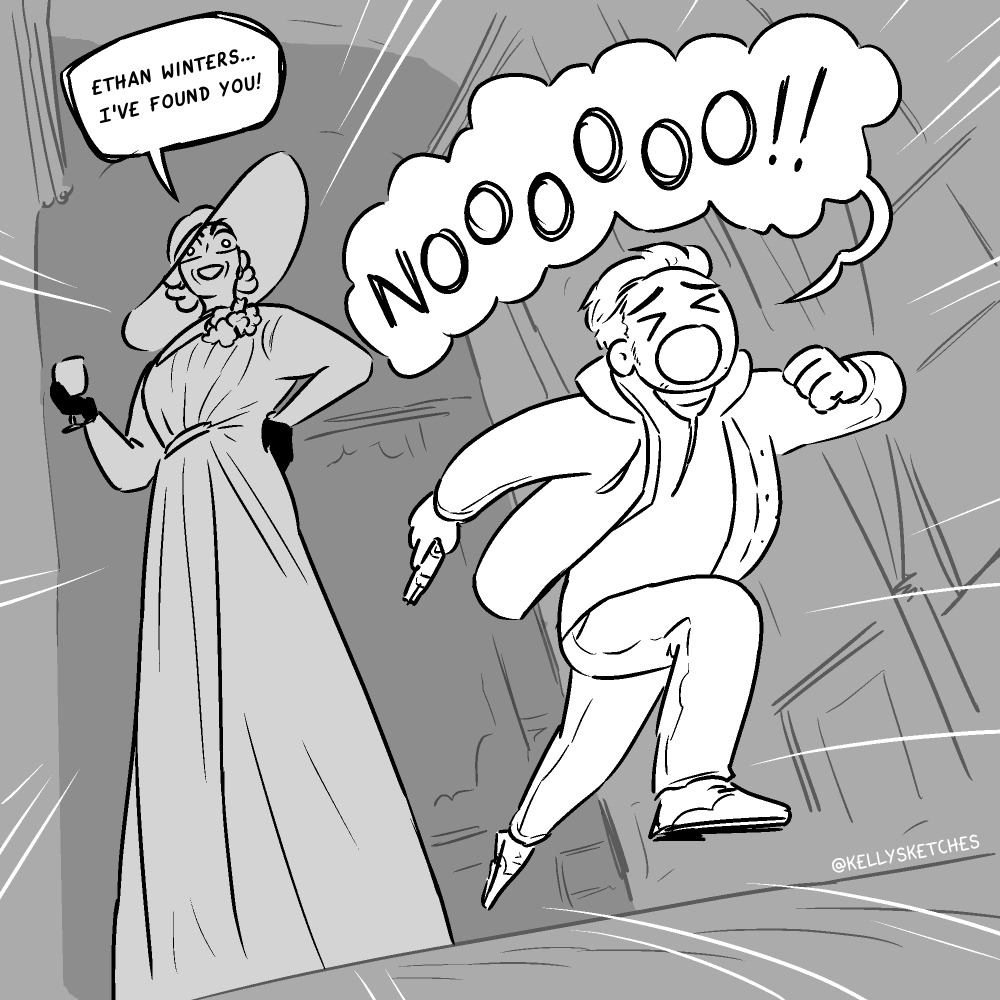
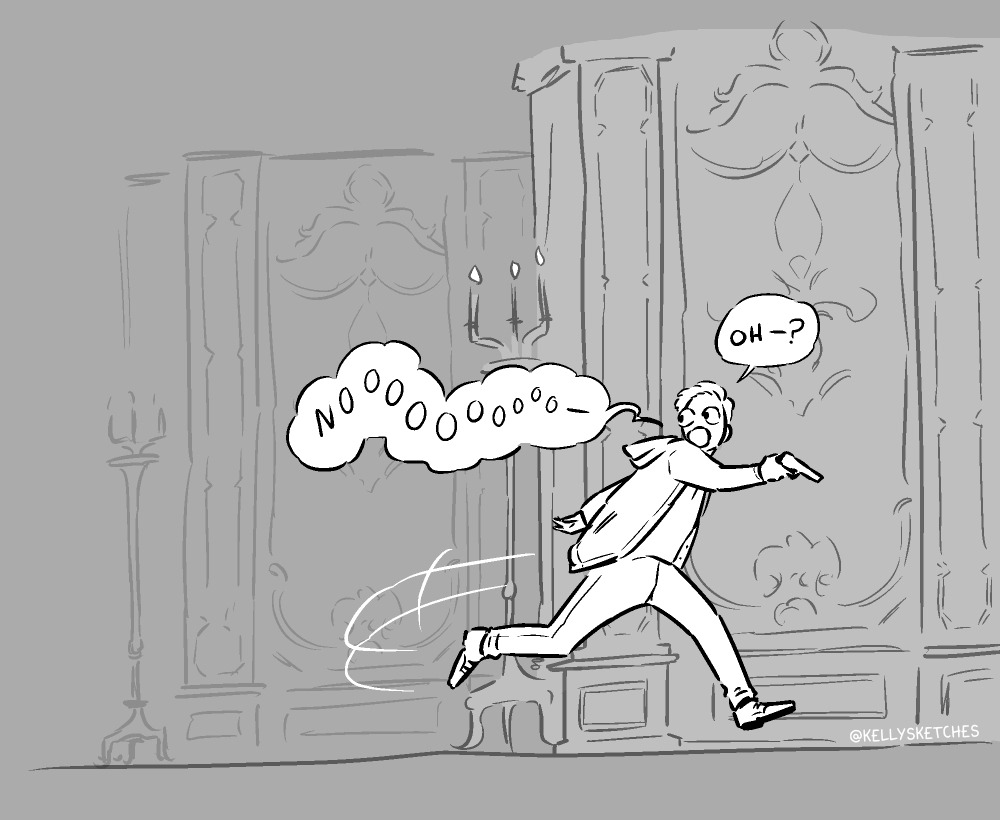
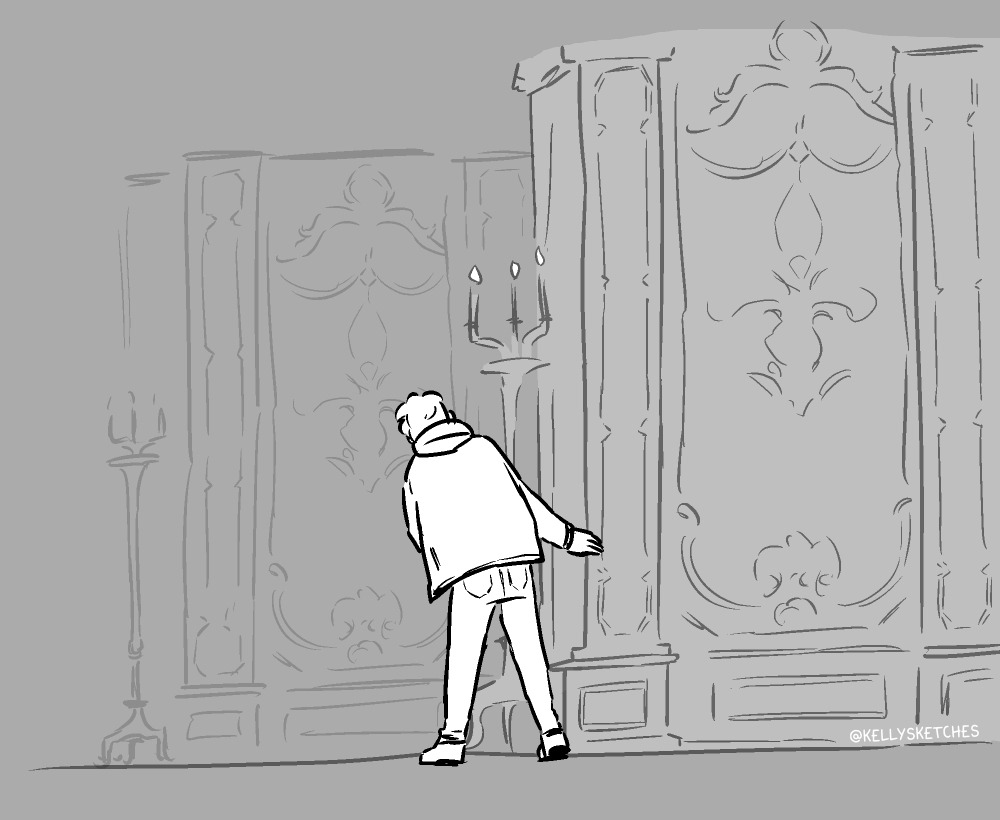
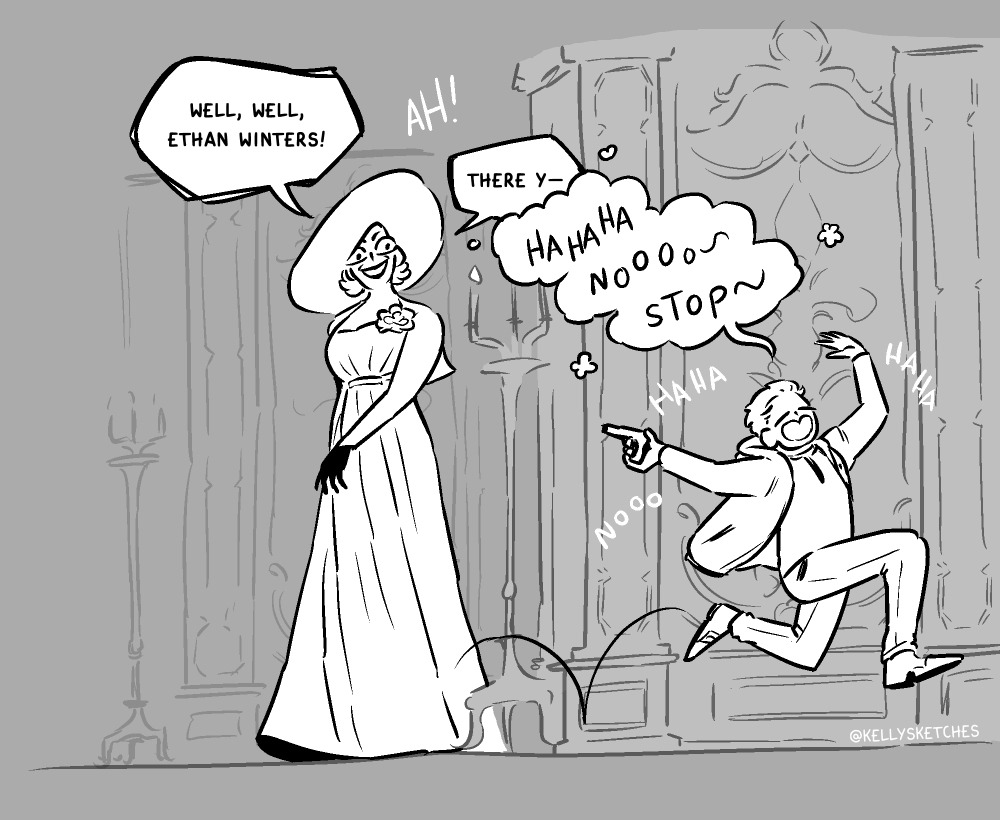
This comic touches on a core truth to the F/m relationship, the point that gets misinterpreted by outsiders. In this comic, Ethan Winters is behaving like the archetypically naughty child: he’s running away from Lady Dimitrescu, at first in self-defense but lastly because he’s defying her authority, savoring the tension between fleeing and hoping she’ll overcome him and catch him. That delicious struggle represents the deep-seated longing to be wanted, to feel desirable. “I’m running away from you, but I hope you want me enough to come after me.”
It’s really not difficult to understand how an outsider could mistake this for some kind of mommy-complex, because the lines are admittedly thin, one impulse echoes another, but the lines are unquestionably in place. Wanting to share this tension with a sexual partner does not mean we’re pining for a missed opportunity in our upbringing.
Debunking the “Mommy” Misconception
Sure, some people’s fantasies may stem from early experiences, but that’s the case with any sexual fantasy. The fact that something was awakened in us during our formative years does not necessarily tie it to that stage of development. It’s just a matter of experiencing something that connects with you, at whatever point in your timeline you encounter it. Let’s say you became a radical Communist during college: Is that because all people ages 20–24 are genetically primed to receive Communism, or because it was an exciting idea you’d never encountered prior to college?
Comfort doesn’t belong to any one encampment. Parenting doesn’t have the monopoly on comfort. Your chosen partner can provide comfort to you, and that comfort can closely resemble what you received (or deeply craved) during childhood: that doesn’t mean your partner is taking the place of your parent. This is just something people can provide for each other or something people can derive for themselves, without reliving a prior state of development. It’s important to bear in mind the difference between emotional comfort and parental association; pretending there’s no difference is unhelpfully reductive and simplistic.
The desire to be cherished and dominated is not exclusively the domain of Size Fantasy. As seen above, it’s a common sexual fantasy that people naturally share, and not because of some developmental incident. Maybe it’s a biological imperative that links our psychological well-being to feeling desirable to others, even in the abstract. Even if we’re not soliciting for a sexual partner, it can still be comforting and reaffirming to feel as though we’re attractive and desirable. It’s a basic need we have, like it or not: we want to feel wanted.
Macrophilia Is Not the Same as Mommy Issues
- The giantess is explicitly sexualized. She’s arousing because of her stature, her confidence, and her power. All of this stands independently from any maternal relationship.
- She’s often dominant. She demands pleasure, she asserts her will, and she enjoys her partner for her own gratification.
- She exists outside of family context. There’s no coded mother–son relationship, none of the trappings of raising children. The giant woman is a fantasy lover, not a stand-in.
- The surrender is erotic, not infantile. Macrophiles fantasize about being shrunken men, offering themselves to a vast, carnal woman who desires them fully.
- Power ≠ parenting. Wanting to be overpowered, cherished, or engulfed doesn’t have anything to do with developmental regression. It means you’re turned on by the intensity, the vulnerability, and the erotic charge of scale.
Certainly, a submissive partner may enjoy being called “good boy/girl,” but it’s still appropriate to divest this from the literal role of a disciplinarian mother. Macrophiles can enjoy the comfort of an overwhelming, overpowering figure, against whom resistance is impossible, that has nothing to do with an incestuous relationship or the reenactment of childhood. One of the greatest difficulties with sexual fantasy is in accepting it: it’s speaking an honest truth about ourselves, who and what we are, that social definitions and strictures have cast as unacceptable. It is entirely possible to blend components and aspects of our lived experiences and repurpose them through our erotic imagination without also burdening them with the context from which they have been derived. The whole point of fantasy is to explore what we like, what turns us on, without being dragged down by real-world context.
To judge and condemn someone else for the inspirational components of their fantasy, attempting to reattach them to their original yet inapplicable context, borders on cruelty.
The Erotic Power of Surrender
Surrender to a greater power means many things. It can mean the abnegation of responsibility: giving control over our choices and existence to someone else, whether a domme or a giantess, can be a sign that we just can’t fucking deal with this shit anymore. Someone else has to take the wheel.
It can also stand as a gesture of supreme trust and even love. We know who we are and what we have to offer; we perceive someone greater than ourselves, we believe in what they’re doing and what they stand for. So much so, that we’re willing to pool our resources into them, if anything we have to offer is of any use to them. It takes an amount of bravery, in this scenario, to relinquish everything we own, everything we’ve done, all our obligations, and give it all to someone else.
These are subversive acts in a patriarchal society where men are not raised with an emotional vocabulary. In an ostensibly “merit-based” society, where men must possess the best skills and create the strongest presentation to attract a mate—and in a society where men make up these fucking rules without, you know, the remotest curiosity as to what women actually want—traits like emotional vulnerability are discouraged. To break yourself down, to stretch yourself out in the palm of a gigantic woman, to offer yourself like a mini-charcuterie to her is transgressive, subversive. It’s a greater show of strength than upending a car or catching a bullet. That kind of openness stands in direct opposition to the fearful defensiveness a patriarchal society perpetuates, always looking out for who’s stronger, who’s better-looking, who’s got more money, etc. To stand in the hand of an exponentially more powerful woman and say “this is who I am, I know my worth, and I give it all to you because I see you and I value you” is a mind-blowing, schism-disrupting gesture of paradoxical power. To be strong enough to be vulnerable goes way beyond Masculinity 101.
The giantess provides the ultimate safe space. The tiny man who can crack his shell and break himself down in this space stands to receive tremendous love, to be controlled by a beloved partner, and to be exposed to someone who will not judge, will only love, adore, and consume in context. Forbidden things are acceptable to the giantess, anything’s possible within her grip. This is not the place to ramp up one’s defenses and thicken one’s barriers—nothing is gained and everything is lost in this posture.
Macrophilia as a Site of Sexual Exploration and Healing
Spend a little time talking to sex workers/performers within the Size scene, and you’ll hear quite frequently how many private sessions don’t involve sex at all. Sometimes the little man just wants to … talk. If sex work ever became a formalized industry, I really hope that rolled into this would be financial grants to permit sex workers to pursue a degree in therapy/counseling. I think this has tremendous real-world relevance.
We plunge into our sexual fantasies to pursue our bliss, yes, but to more fully realize that bliss we have to come to understand ourselves. Many macrophiles find great difficulty in accepting and expressing this aspect of themselves, and their fears aren’t unwarranted. I’m aware of people who’ve lost relationships because they started dating someone new, quickly launched into confessing their sexual kink (with the implied hope that their partner would participate), and consequently lost that relationship. We’re afraid of what friends and family would think, if only they knew about this terrifying, disgusting aspect to ourselves.
Well, it’s not terrifying, and it’s not disgusting. Like I said at the onset, it’s statistically common. It just looks a little different because instead of riding crops, nipple clamps, and cannisters of Reddi-Whip, it’s gigantic women.
Read through the interviews Solomon G has posted in this blog. You’ll see it’s not unusual at all for creators, people bold enough to put their talents to manifesting their desires creatively, to also experience some shame around their craft and their attractions. People into giantesses will say things like, “The giantess wanted me, desired me. She didn’t care how small I was. She made me matter.” Sometimes the fantasy may come from a place of struggling with self-worth or emotional neglect; embracing it, learning to accept it in ourselves is not a matter of re-parenting: we’re reclaiming ourselves, we’re owning who we are. Indulging in the fantasy allows us to shout back to the universe that we’re here, exactly as we are. Fantasizing about someone so much huger than us, someone who sees us and wants us, can’t be bad.
From Pathology to Possibility
I can’t say it enough: Size Fantasy is a valid, healthy, and complex erotic expression. It has everything in common with the most popular self-reported sexual fantasies of people in the United States (and likely the world, but we have no stats for this—outside of Clips4Sale’s annual reports). It’s not a sickness, it’s not evidence of something broken within us. It’s just something we’re into, and in lots of ways, meaningful ways, it resembles what everyone else is into.
Stop and think about this for a minute. What does it say about our society, that so many people crave to be held, cherished, and overpowered by a loving figure? Perhaps exploring it would teach a lot of people about themselves, learn to safely explore vulnerability and embrace their own pleasure. One can only dream that it could entail a new respect and reverence for women …
This editorial was written by Aborigen and is protected under Fair Use copyright law.
All Rights Reserved.
 There She Grows
I absolutely understand the need to say “this is not at all what it looks like to you” to outsiders who have just that one box into which they can imagine to put our generally shared kink. And I understand it would perhaps seem to undermine the point to mention that for not just a few of us, it seems to be quite literally about mommies, adoption, unbirthing, regression, entrapment, rebirthing, breastfeeding and all the other tags…
However, I feel none of that runs counter to your point in any way. Because literal does not mean real. And I’d offer that, while many people in the size zone do fantasize, write stories and draw images about all the things listed above, I bet that close to none of them are “pining for a missed opportunity in their upbringing” and certainly haven’t felt or do feel sexual attraction to their own real-life mothers. I much more believe that despite the use of those encodings by size fans themselves, the desires behind those scenarios are still one of general authority, submission, overwhelming attraction, power, caregiving, commitment etc. – just like you put it. It’s just simply that also for those inside the size zone, the word ‘mommy’ to many is the nearest, most immediate code. The most powerful real-life association that instantly manages to evoke the yearning out of a familiar box.
So perhaps this comment here now is a long-winded way of saying that it’s maybe not just the imagination of outsiders that limits us, but that those limitations are also affecting us on the inside. And that those of us who use such codes could perhaps try to break free of them, and define something new for what we lust after – not mainly because of how we may appear to outsiders, but to ideally broaden everyone’s horizon on the infinite ways in which trust, love, commitment, devotion and lust can take shape between all of us.
LikeLiked by 3 people
I appreciate the generosity of your expression here and the nuance you’re bringing to this topic.
It’s absolutely true that some people do pursue mother-lusting kinks within Size Fantasy or kinks adjacent: adoption, breastfeeding, unbirthing, regression, etc. It’s also true that we may currently lack a vocabulary to name these interests that blur the lines or sound too familiar to an earlier state. it was just important for me to assert that having the Size kink does not necessarily mandate or equate to lusting after one’s mother, as has been charged in the past.
While I don’t enjoy the casual reapplication of “mommy” (just like my skin crawls when people use “slave”) in pursuit of an orgasm, it’s true that it may be convenient to reach for the most immediate and culturally laden codes, like “mommy,” to approach the experience. I would suggest this practice also becomes limiting over time, running the risk of flattening the complexity of what we’re actually pursuing and working with.
Thank you for engaging with your customary degree of insight. This is the kind of conversation I look forward to.
LikeLike
I appreciate that this essay is limited to F/m Size Fantasy and rebutting the specific simplistic claim about “Mommy issues,” but I think its arguments could be easily applied to most any “tiny-identifying” Size fetishist. The relinquishing of control, being the target of desire from a vast overwhelming or almost divine person, unconditional protection and comfort, the privilege of access to someone literally out of reach—all of these hold universal appeal, regardless of one’s childhood experiences.
Ironically, tiny-identifying straight women get their own messages of social disapproval from people who think women should always be fighting against male supremacy and asserting their own autonomy. I have received uniformly positive responses from tiny-identifying female Size fetishists when I treated them in one of the many ways that I have often looked for in a giantess. From gentle protection to earnest dominance to selfish lust, they want it all from me, but I have never uttered the phrase, “Who’s your Daddy?”
I think there’s a lot to the seven “basic” fantasies that Lehmiller identified, although I would not encourage anyone to try to fit their personal fantasies into one or more of those categories. These thoughts and feelings are too complex for that. Let your fantasies remain exactly that; yours.
LikeLiked by 1 person
I readily agree with this: I chose to narrow the focus of my essay both to address the problematic topic and to speak strictly from within my lane. But there is no reason the lessons and the relationships couldn’t apply to many other permutations. I would suggest that Size Fantasy sometimes resists easily psychological shorthand, especially as we’re coming at it from varying cultures and societies and from different generations.
Your observation that tiny-identifying straight women receive especial obstruction and disapproval is imperative to note. On top of the standard shame and stigma of a sexual kink, it also suffers attack by political inflexibility and policing within the “community.”
As for Lehmiller, his findings are a great springboard for further exploration and development. I listed stats and percentages, but it would be irresponsible to act on that as though we’ve uncovered a cosmic law. Everything only suggests, indicates, hints at a direction or a trend. I wouldn’t want anyone to look at the popular fantasies he identified as a zodiac with which to identify—I can only stress it’s presented to show us how we’re all connected and what we have in common, despite outward appearances.
LikeLiked by 1 person