
Good morning everyone,
This November There She Grows will review a few novels featuring size themes. (SIDE NOTE: And if time permits I will try to squeeze in a look at a CGI growing giantess video.)
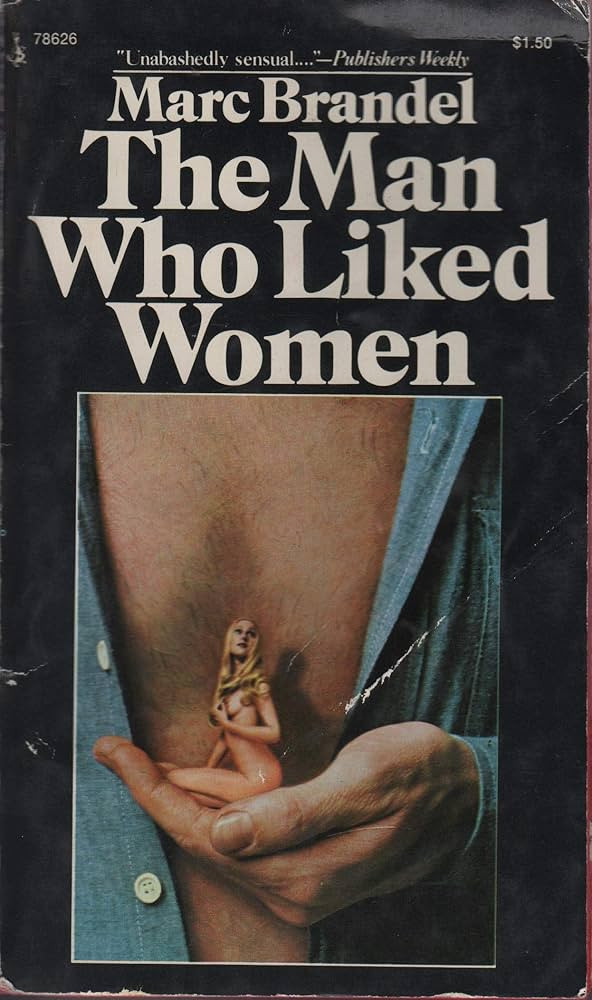
First up, I will dive between the covers of a groovy paperback from the 1970s. Marc Brandel wrote “The Man Who Liked Women” which Simon & Schuster published in 1972 and a division of Simon & Schuster called Pocket Books reprinted in 1974.
Marc Brandel (originally Marcus Beresford) was an English author born during late March 1919 in London, England. After a brief stint in college and after serving as a Merchant Marine in World War II he alternated between living in England, Ireland, and the United States. He wrote a number of episodes for various television series such as “Barnaby Jones,” “Burke’s Law,” and “Danger Man” a.k.a. “Secret Agent.” (Comment below if you have heard about or seen any of those shows.) He also wrote an episode of the original “Fantasy Island.” I watched that series when I was a little kid. Brandel may be best known for writing “The Lizard’s Tail” which was adapted into the 1981 horror film “The Hand.” Oliver Stone directed that film starring Michael Caine. Brandel wrote several novels including a few books in the Three Investigators series, a juvenile detective series which began as “Alfred Hitchcock and the Three Investigators.” Tragically, Marc Brandel committed suicide during mid-November 1994 in Santa Monica, California.
The Man Who Liked Women features an American engineer called Bascombe Helmut Fletcher working for an American company in London. His duties are to help his boss Mr. Mitchel convince British politicians to put calcium fluoride in their public drinking water. (NOTE: One might feel a tinge of jealously at Bascombe’s undemanding job, “fairly comfortable salary,” and copious free time to woo lovely English ladies. I know I do!)
Bascombe is the titular “Man Who Liked Women.” However, he was not a man who counted how many women that he had slept with or a man who worried about the women that turned him down. He did not keep score or worry about his “body count.” Instead, he was concerned only with endless courting and romancing women. The initial meetings then the stops and starts along the way to physical intimacy were the only things that truly mattered to him in life.
One night he experiences a terrible headache. The pain increases until it reaches such a high level of discomfort that he looses consciousness. Upon awakening he discovers a tiny one-and-a-half-inch tall woman in his apartment. Thus, he gave birth to a small person via his head. (As one does…) A strange phenomenon to be sure, but doubtlessly the author took inspiration from the birth narrative of the ancient Greek goddess Athena. Although, after awhile we learn that the tiny goddess in this story is actually the Greek goddess Aphrodite, known to the Romans as Venus.
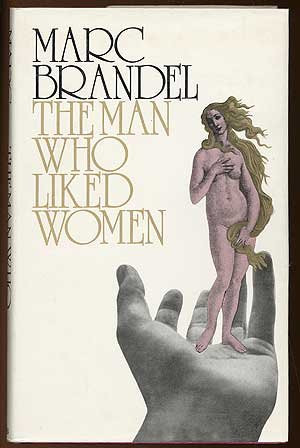
There is a long period in which the two struggle to communicate because she was accustomed to the cultures and languages in the ancient Mediterranean not to the cultures and languages, such as English, in the 20th century United Kingdom. However, they eventually learn to communicate. While their relationship blossoms Venus steadily grows larger at a rate of an inch per week. This continues until she reaches normal human size and then a bit beyond! (NOTE: The narrative included a realistic portrayal of the health problems experienced when a human becomes extraordinarily tall.)
The couple travel to Ireland and then to continental Europe sightseeing and making love in various cities and towns. (Did I mention a tinge of jealousy?) At one point they are involved in a student uprising in Paris which becomes violent. (NOTE: Presumably, the Paris segment was inspired by May 68.) The story’s ending was bittersweet, but satisfactory.
Beyond the appeal of size fetish this was an engrossing trek through peaceful countries plus riotous countries in late 1960s Europe and that alone was worth a read. As previously mentioned this was first published in 1972, more than 50 years ago, so some references may not by familiar to modern readers. For instance I knew who American politician Barry Goldwater was, but I cannot claim that I was super familiar with him. Furthermore, a reference to a celebrity called Gloria Stuart meant nothing to me.

Regarding critiques, the arrival of an actual superhuman presence (an immortal not only worshiped as a Greek goddess but also an important figure in other pantheons) on Earth had less impact than folks might expect. She garnered fame and public recognition, but she actively refused to significantly influence humanity even in one instance when she might have made a big difference.
As for Bascombe, he was a bit of an enigma. Given his overriding desire to romance women one might expect him to be a misogynist who considered females as merely things to be conquered then discarded. However, the author portrayed Bascombe as someone who never mistreats his romantic partners and does not end the relationships immediately after they have sex. The creator tried to show Bascombe as a man who honestly cared for women. Although, one could argue that Bascombe did not display interest in learning about women as people, but merely in giving them what they wanted so he could then enjoy their bodies. Furthermore, and this next point is vague because I do not want to spoil the conclusion, at the end someone offers Bascombe a gift which he refuses. Presumably, Brendel intended readers to think that Bascombe had undergone character development and refused something that he would have gladly accepted at the beginning of the novel. However, I am not certain that Bascombe would have refused that gift at the start since he was never portrayed as inconsiderate or uncaring with his romantic partners. So, I am not confident that he actually experienced character development.
Still, this was a solid read with a nice ending. If anyone is looking for a sensuous novel with a size fetish theme then I highly recommend The Man Who Liked Women. The small lady slowly grew larger with each day, but a good deal of time was spent with her as a tiny to include several explicit sex scenes
Next week I will review “Fifty Feet of Trouble” by Justin Robinson. Until then, keep growing!

This review was written by SolomonG and is protected under Fair Use copyright law.
All Rights Reserved.
 There She Grows
Piers Anthony’s “The Bridge” is my favorite SW story.
LikeLiked by 1 person
I bought a copy of his “Golem in the Gears” which I need to read soon.
LikeLiked by 1 person