
Good morning everyone,
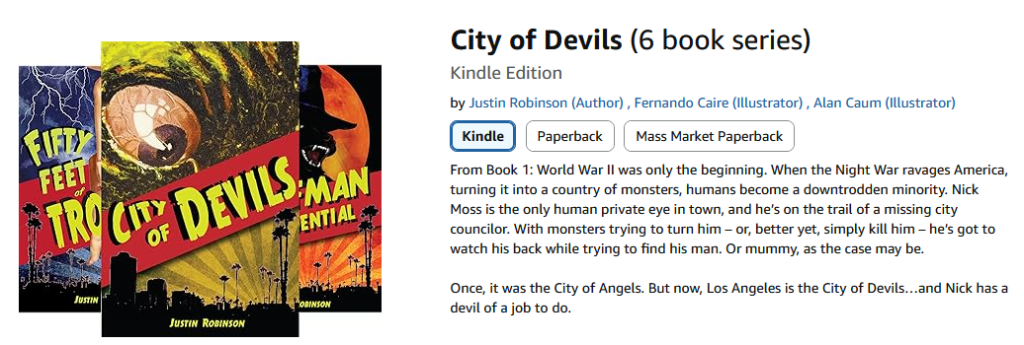
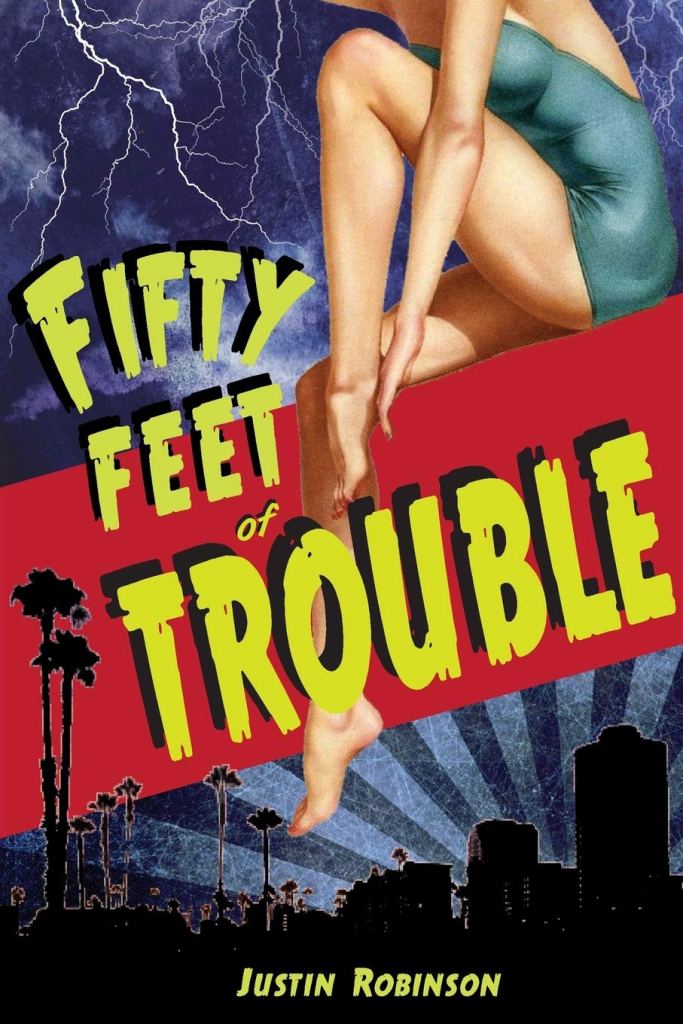
Last week we went back in time to a novel penned in the 1970s, but this week we will rocket forward to the 2010s. Today’s novel is “Fifty Feet of Trouble” by Justin Robinson. Fifty Feet of Trouble released on October 31, 2016.

Of note, this is the second entry in Robinson’s “City of Devils” series.
I have not read the first book nor any of the others. However, the author provided enough background information and flashbacks to ensure the narrative was understandable.
The series features Nick Moss, the only remaining human detective in an alternate 1950s Los Angeles. After World War II in this parallel reality a supernatural conflict, called the “Night War,” broke out. During the Night War monsters appeared and fought against humanity for control. (NOTE: Click here to learn a bit about some of these supernatural beings at Robinson’s official webpage.) These included crawling eyes, doppelgangers, Martians, robots, sirens, and werewolves to name just a few different types. (NOTE ON AN UNEXPECTED CAPITALIZATION ERROR: Robinson lower-cased “Martians” and that made my eye twitch!)
In Fifty Feet of Trouble Nick pursues several missing person cases plus a missing familiar case in which someone kidnaps a witch’s toad. This review will not spoil any more details to preserve a few surprises, but it will mention that everything wraps up with a neat little bow at the end.
I enjoyed the world building and Nick was an engaging character. On the one hand he was a stereotypical private eye. Meaning that he was a combat veteran trying to make a living by leveraging his Army skills in the civilian world. On the other hand he was a short small man with an unexpectedly high voice. That did not diminish his prowess in a fight, but did make him different than the average square-jawed action hero.
Regarding the monsters, they were divided into niche sub-classes. For example there were not just werewolves, but also wolfmen. This particular book did not explain the difference between those two lycanthropy variants. In contrast this book clearly detailed the differences between bloodsuckers splitting them into nosferatu and vampires. Aquatic humanoids were also bifurcated into gill-men and sirens, etc., etc.
There was not an overarching theme to the monsters per se. There were aliens like Martians, magical spellcasters like witches, sci-fi mainstays like mad scientists and robots, etc. That can make it a little confusing if you are expecting a common thread to tie them all together. Instead, they are based on horror and science-fiction tropes popular in American films made between the 1930s and 1950s. All of the monsters had been seen before. Therefore, fans of mid-20th century American drive-in flicks will love them! However, the characters can feel derivative as none of their archetypes were new.
For me, the most challenging part of this work was a potentially mismatched tone. Aspects of this fictional universe were quite dark. Frightening creatures such as doppelgangers, ghosts, and pumpkinheads regularly harass humans. According to the Fair Game Law, passed after a treaty ended the Night War, monsters are legally permitted to take and turn humans at night. Presumably, they are also authorized to kill since some monsters, like nosferatu and vampires, need to feed on humans and others, like ghosts and zombies, need to kill to transform humans into the undead. This means they are allowed to break into people’s homes and snatch them and their children after the sun goes down. So, superhumanly powerful stalkers camp outside people’s homes while the hapless residents rely upon multiple wards (such as crosses, evil eye charms, feathers, wind chimes, and so on) to keep those threats at bay. Therefore, our protagonist Nick had learned to live with deadly creatures trying to entice him to let them in every night. That is a horrific living situation, particularly for parents. Yet, this was an action-packed detective yarn, not horror.
Regarding the giantess, the titular Fifty Feet of Trouble, she did not actually appear until after the first third of the story. Pilar O’Heaven, the only human giant living in Los Angeles, was involved in the narrative, but not as much as a reader might assume given the title. Nonetheless, her daily swim from the mainland to a nearby island, to the delight of tourists, was a neat addition. Nick was already working multiple cases before he met Miss O’Heaven. She merely gave him an additional task to complete. Still, O’Heaven had a role to play at the end and she was likable.
There was no sex in this novel and our hero Nick did not so much as kiss anyone. Although, a few wannabe paramours tried to kiss him. In one instance he had to actively dampen the amorous intentions of a catwoman, a member of the balam or jaguar people. The jaguar people normally look like highly attractive humans, but change into jaguars when they are sexually aroused. Then they erupt into deadly violence, often killing their would-be lovers. (BACKGROUND NOTE: Presumably, the jaguar people were inspired by the 1942 film “Cat People.”)
Overall, this was a good story with a small bit of giantess action and a big bit of humor. I recommend Fifty Feet of Trouble to fans of mysteries with the added wrinkle that among this particular private investigator’s clients was a 50-foot tall well-built blonde.
That is it for today folks. In about two weeks I will review “The Thunderbird Project” by Rebecca Harwell. Until then, keep growing!
This review was written by SolomonG and is protected under Fair Use copyright law.
All Rights Reserved.


I have a signed copy of Thunderbird Project I snagged of off Amazon. I look forward to your review.
LikeLiked by 1 person
I have a signed copy as well! Albeit mine was used and dedicated to someone else. Won’t spoil the review, but will say Thunderbird Project is a 90s era dark comic book in written form.
LikeLiked by 1 person
You are very eloquent and charitable.
LikeLike
I could include your thoughts about Thunderbird in my review! If that sounds fun drop me a line at solomong_author@outlook.com
LikeLiked by 1 person