
Good morning everyone,
Today’s final post is a review of a silent film entitled “Professor Puddenhead’s Patents: The Electric Enlarger” directed by Walter R. Booth. From now on I will simply refer to it as “The Electric Enlarger” for the sake of brevity. Special thanks to Taedis, archivist and founder of the Size Library and Museum (SLaM), who recognized this film’s significance then alerted me to its existence.

My heartfelt appreciation also goes out to the Dawson City Museum & Historical Society for maintaining this silent film for posterity’s sake. As someone born in Alaska I feel a bit of a kindred spirit with the people of Dawson City in Canada’s Yukon Territory which borders much of Alaska’s eastern half.
On the topic of preserving The Electric Enlarger, its continued existence is perhaps not widely known since at least one person considered its survival status as lost or unknown.
Regarding the cast and crew, unfortunately I was unable to find the names for the actors, the men and women plus a cute dog, who appeared on screen. Walter R. Booth was the director and he made this film for Charles Urban’s Trading Company. Additionally, per the British Film Institute, Booth employed Harold Bastick as his cameraman during the time when Booth worked for Urban so it is probable that Bastick was the cameraman who filmed The Electric Enlarger.
Walter Robert Booth was a stage magician and early cinematographer who produced a number of silent films. (NOTE: I took biographical details from the Encyclopedia of Science Fiction.) He was born in Worcester, England, in 1869. Booth made his first film, “The Miser’s Doom,” in 1899. Booth then produced science-fiction such as “An Over-Incubated Baby” in 1901 featuring a miraculous incubator built to age babies by 12 months but it malfunctions so a baby comes out of the machine looking like an old man with a beard, “The ‘?’ Motorist” in 1906 featuring a motorist who drives his car up a wall then circles the moon and traverses the cosmos (as one does), and “The Automatic Motorist” in 1911 featuring a robot chauffeur. Booth’s productions did not have much of a plot, but they did have special effects which were probably impressive for the early 20th century. To be fair, the runtimes were ten minutes or less and did not lend themselves to possessing extensive plots. (SIDE NOTE: Most of the films mentioned in this paragraph can be viewed on Wikipedia.)
In most if not all of Booth’s cinematic productions he apparently intended merely to demonstrate a specific special effect instead of telling a story. For example, An Over-Incubated Baby showed that Booth could make a baby turn into an old man. He gave no reason for why a mother would want to age her infant by 12 months. I could sympathize with a parent wanting to skip tedious exercises such as potty training, but hearing a baby say “Mama” or “Dada” then taking their first steps are precious milestones many parents (at least speaking for myself) would not want to miss. Similarly, The ‘?’ Motorist drove up a wall then into outer space simply because they could and for no other discernible rationale. Moria Reviews covered Booth’s “The Airship Destroyer” and came to a similar conclusion as I did. This is not to disparage Booth’s works, it is cool to watch what was then innovative cinematic techniques, but this analysis is merely to inform readers that Booth’s films do not have complete narratives. Questions like “how” or “why” something was done go unanswered.
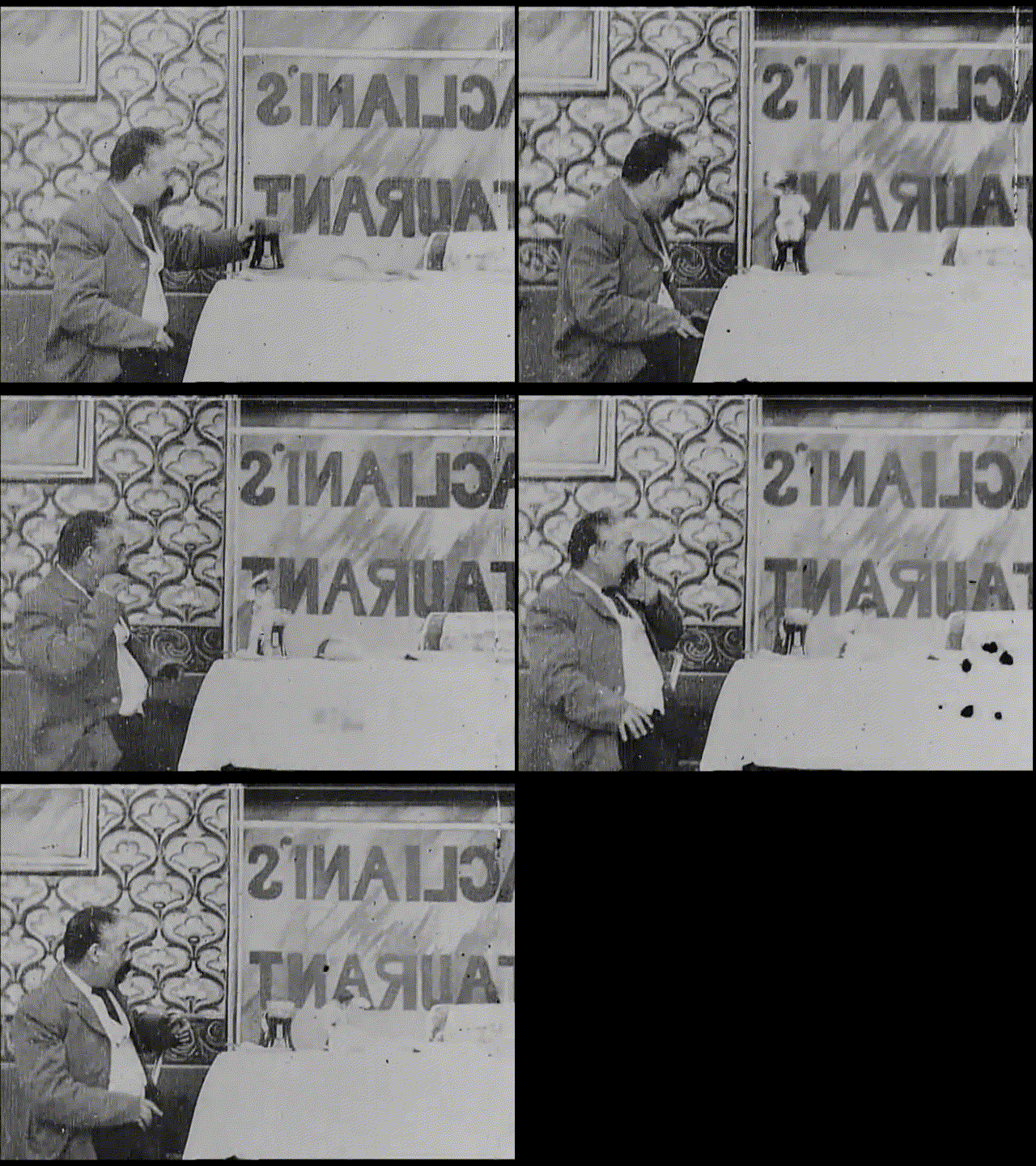
Booth previously released a one-minute long film in 1901 featuring tiny people called “Cheese Mites, or Lilliputians in a London Restaurant.” A short GIF from Cheese Mites is shown below:
Booth was not the very first movie maker to show humans changing size or giants and tiny people. Arguably, French director Georges Méliès beat him to that title. Short films by Méliès such as “Gugusse et l’Automate” (Gugusse and the Automaton) [1897] featuring a human-like automaton that changes size, “L’Homme A La Tete En Caoutchouc” (The Man with the Rubber Head) [1901], Le Diable Geant ou Le Miracle De La Madone (The Giant Devil or The Miracle of the Madonna) [1901], and Nain Et Geant (Dwarf and Giant) [1901] also played with size themes. Even though he was not first, Booth certainly was among the pioneering generation in France and the United Kingdom.
Booth produced at least three films starring Professor Puddenhead. The first was “Professor Puddenhead’s Patents: The Aerocab and Vacuum Provider” in June 1909, then today’s subject The Electric Enlarger in July 1909, and lastly “The Electric Servant” in September 1909. (NOTE: Information about those titles and their release dates was taken from “The British Film Catalogue” Vol. 1 3rd edition by Denis Gifford.)
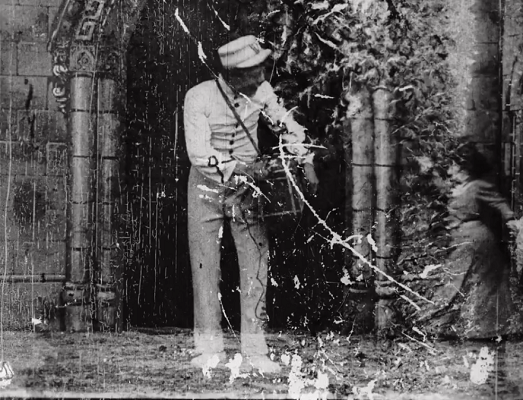
As for the story of The Electric Enlarger, the action begins with Professor Puddenhead demonstrating to two gentlemen an invention in the form of an electric wand that makes things bigger. After transforming a small handheld picture into a full-size portrait, the professor enlarged an insect. Then his assistant stole the invention and ran around town causing mischief by enlarging a woman’s dog, a man’s shovel, a caterpillar, a man’s head, another man’s top hat, and a constable’s shoes. Eventually, the assistant makes his entire body gigantic after which the surviving footage ends abruptly. Presumably, the action was meant to continue for at least several more seconds, but no one knows what the intended runtime originally was.
Additionally, the Dawson City Museum themselves claimed that The Electric Enlarger had English intertitles, but neither I nor Taedis have seen those. They may have been lost or never existed in the first place. Lastly, this film has degraded over the years and the picture was often heavily scratched and distorted to the point where some scenes were obscured.
Overall, I recommend anyone who is interested in the history of cinematography check out The Electric Enlarger. Obviously, the special effects will not be convincing to modern audiences, but they represent a magician showing off to cinema’s earliest audiences what tricks could be accomplished using jump cuts, mattes, oversized physical props, and superimposition. History buffs can watch The Electric Enlarger by clicking here for the Internet Archive.
That is it for today folks. Until next time, keep growing!
This review was written by SolomonG and is protected under Fair Use copyright law.
All Rights Reserved.
 There She Grows