
Good morning everyone,
Today we’re looking at the career of monster movie maker Bert I. (Ira) Gordon, also known as Mr. B.I.G. Bert was an American film director, screenwriter, and special effects supervisor. He passed in early March of this year, at the age of 100, and thus it’s time to look back upon his movies.
CONTENT WARNING: This article includes a brief discussion of a sexual assault. Reader discretion is advised.
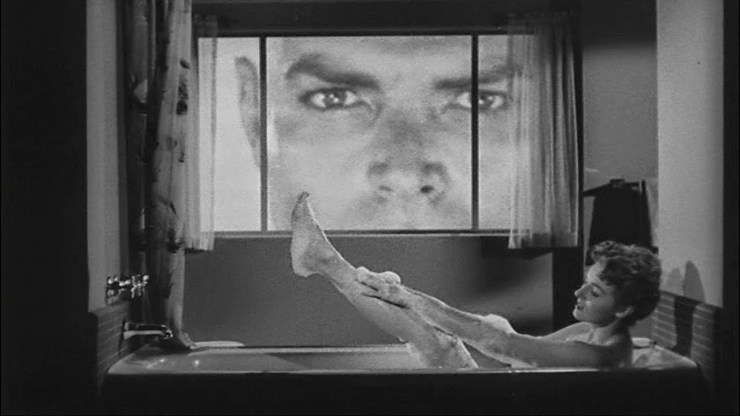
Fans of giant and tiny people may recognize Bert I. Gordon as the creator of “The Cyclops,” “The Amazing Colossal Man,” “War of the Colossal Beast,” “Attack of the Puppet People,” and “Village of the Giants.”
He also created movies featuring gigantic beasts and filmed real animals, such as ants, grasshoppers, iguanas, rats, and tarantulas, to represent their monstrous equivalents. That habit of using real animals led to less-than-convincing visual effects. Comparing Bert’s use of live ants to the oversized ant puppets in 1954’s “Them!” Them’s giant prop ants were able to lunge at and grab actors. Them only used puppets to represent the enlarged ants and thus they looked consistent from one shot to another. In contrast, Bert’s “Empire of the Ants” combined live-action footage of real ants with footage of puppets and thus his monster ants looked inconsistent from one shot to another.
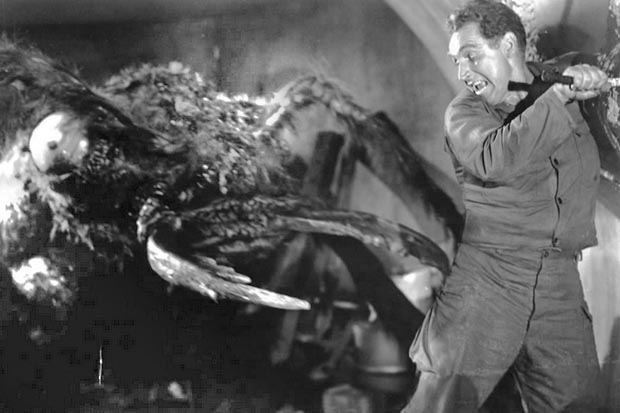
To be fair, Them’s puppets were sometimes rolled into view on dollies so their smooth forward movement looked unnatural, like the ant was rolling on wheels not walking on legs. However, they were a more effective visual effect than composited footage of real ants.
Furthermore, Bert took great pains to find specific live animals. For Empire of the Ants, he flew to Panama for jungle footage of a specific type of ant, the paraponera clavata (a.k.a. the bullet ant). That species is fairly large (0.7 to 1.2 inches) and has an extremely painful sting. Surely, the cost of airfare, lodging, and food for that foreign expedition could have bought some decent puppets. Alternatively, Bert could have simply filmed the ants that live in Florida. An American ant would look just as horrifying as a Panamanian ant if made to appear 50 times bigger.
Famous celebrities such as Lon Chaney Jr., Orson Welles, Joan Collins, and Zsa Zsa Gabor appeared in his productions. Most of those performers, such as Lon Chaney Jr. and Orson Welles, were in the twilight of their careers. One exception was Joan Collins who appeared in Bert’s “Empire of the Ants” in 1977, but later cemented her fame in the TV show “Dynasty” during the 1980s.
Bert actually produced a number of films in various genres. Examples beyond the monster genre include the horror of the ghost story “Tormented,” suspense in “Picture Mommy Dead,” family-friendly pirates in “The Boy and the Pirates,” fantasy in “The Magic Sword,” sex comedy in “How to Succeed with Sex” and “The Big Bet,” witchcraft in “Necromancy” (starring Orson Welles), “Burned at the Stake,” and “Satan’s Princess.”
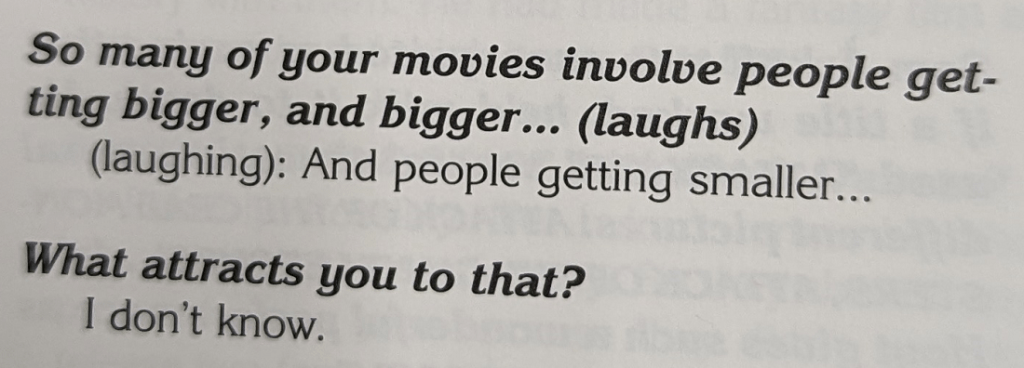
Notably, despite his long history of making films involving giants and tiny people, Bert never claimed to have a particular affection for the trope. When Marty McKee interviewed him in March 2003 and asked why giants animals were so interesting Bert simply replied “I don’t know.” (That was during the University of Illinois’ Insect Fear Film Festival held every spring since 1984. Click here to read that interview in full.)
In an article published by Video Watchdog in 2000, Bert was asked a similar question and gave the exact same answer.
In that interview, Bert also claimed that 1992’s “Honey, I Blew Up the Kid” was a remake of The Amazing Colossal Man. That is simply not true. The only thing the two films have in common is that humans grow bigger, which is not a unique concept.
Based on his filmography, people have understandably tried to present him as a fan of giant monsters. In 2010 James Rolfe, the Angry Video Game Nerd and founder of the YouTube channel Cinemassacre, asked Bert how he first got interested in creating larger-than-life monsters. However, Bert replied with a childhood story of how his aunt gave him a 16mm movie camera and that started his film-making career. He did not actually address the question about larger-than-life monsters.
Additionally, when asked about his early inspirations he did not reply solely with gigantic monster flicks like 1933’s “King Kong” instead he answered that he was inspired by all movies (including, but not limited to King Kong) and said, “I just want to make movies.” (Click here for James Rolfe’s interview with Bert on YouTube.)
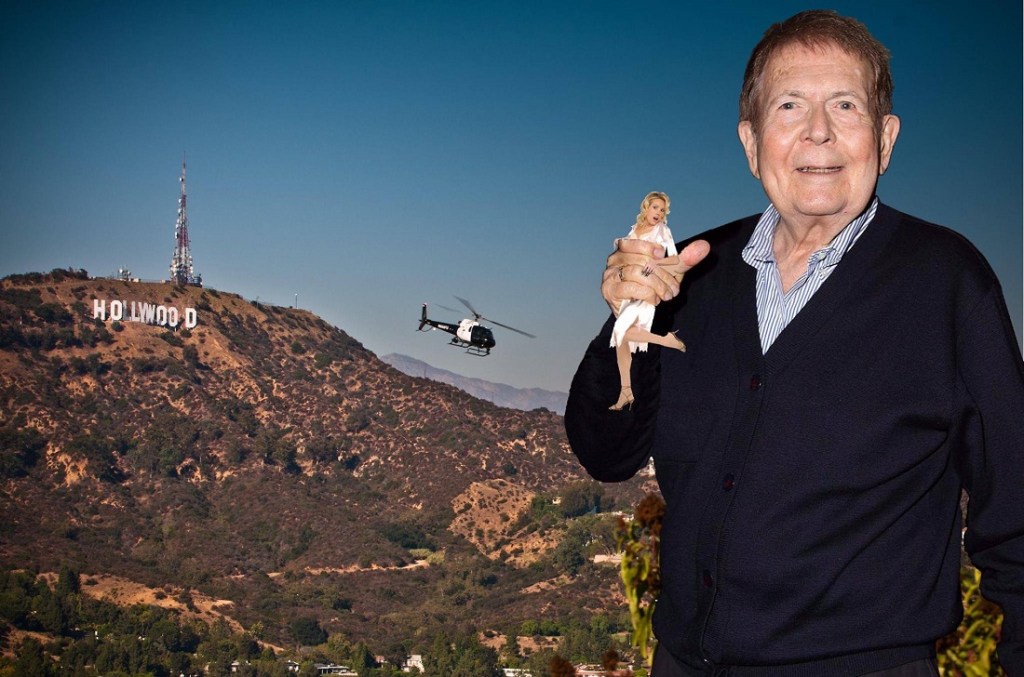
The reason Bert made giant monster movies was merely because he started making films in the 1950s when audiences were anxious about nuclear weapons and radioactive mutations. If Bert hadn’t made The Amazing Colossal Man or Village of the Giants then someone else, like fellow low-budget movie maker Roger Corman, would have.
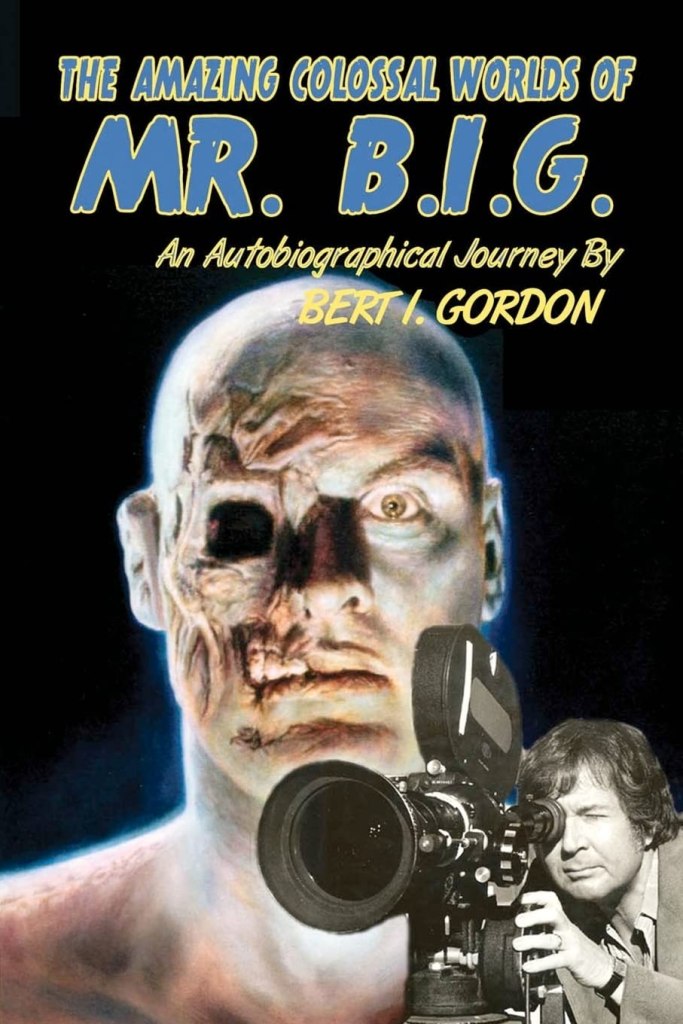
Bert was born in Wisconsin during late September 1922. He was deeply interested in cinema from an early age. In his autobiography, “The Amazing Colossal Worlds of Mr. B.I.G. An Autobiographical Journey By Bert I. Gordon,” Bert wrote that he used to go to the movie theater (starting at the age of 6) every weekend and would stay there, by himself, from 10 in the morning until his mother picked him up for supper. (Hard to imagine a parent leaving their six-year old child unsupervised all day at the theater.) He eventually befriended a stage manager and occasionally assisted the projectionist when a film broke.
At the age of 9, Bert’s Aunt Jean gave him a 16mm movie camera. Bert learned visual tricks such as creating “ghosts” and “twins” using double exposures. He also bought a still camera and made money taking photos of store fronts and window dressings and selling those pictures to the businesses.
After high school he went to college at University of Wisconsin–Madison. (NOTE: According to the New York Times, Bert left college to join the military during World War II.) Bert’s autobiography does not list whether or not he graduated. Nor does the book mention his military service, but I’ll discuss that later. After leaving the military, he moved to St. Paul, Minnesota and made a living creating television commercials plus at least one documentary.
Bert decided that he really wanted to make real movies and thus he moved to Hollywood. He then spent over a year trying to break into the industry.
(SIDE NOTE: It would have been interesting to learn how Bert supported himself and his family while being unemployed for well over a year. Were they ever at risk of becoming homeless or going hungry? His autobiography doesn’t address that question, nor do any of the many interviews in various magazines. I assume he saved enough money from making commercials to support him and his family for an extended period before he found work.)
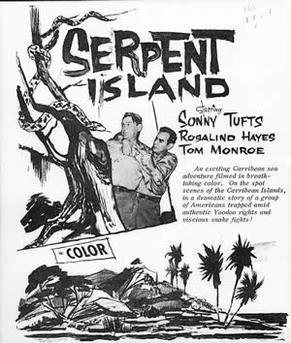
Eventually, Bert made his film debut in 1954’s “Serpent Island.” This led to 1955’s “King Dinosaur” and then 1957’s “The Cyclops.” Bert soon established a reputation for cheaply-made independently-produced science fiction.
Of note, the first sentence of the autobiography reads “Instead of being born with a silver spoon in my mouth, as the cliché goes, I think I was born with visions of movie film whirling around inside my head.” Presumably, Bert wrote that to establish that he was a self-made man. He was not born into a rich family which enabled a privileged upbringing. Nonetheless, he managed to achieve a certain level of fame in the movie industry. He never won an Oscar, but he did create giant monsters that thrilled kids and teenagers in the 1950s and 1960s.
I think there’s some truth to his claim of being a self-made man. He was a nobody when he arrived in Hollywood and through persistence he managed to break into the industry and create films which are still remembered to this day.
However, I also think Bert did not properly recognize the advantages which were given to him. His immediate family had enough money to take him to the movie theater every weekend. An extended family member had enough money to buy him a movie camera, etc. That’s not to claim that his family was rich, but he did benefit from a middle-class upbringing. Not everyone who loves cinema and wants to make their own movies has that level of support.
Now I would like to discuss the aforementioned autobiography in more detail. Unfortunately, the word that comes to mind when describing this book is “lazy.” Before explaining why, let me first outline the basics. It is 274 pages long and was released in mid-March 2010. Bert is listed as the sole author, although he did thank Bruce Kimmel for proofreading and providing unspecified formatting suggestions.
Why do I consider this book “lazy”? For one, it has low-value filler material and unnecessary padding. The longest section is Chapter Thirty-One “Pictures and Stuff” which runs from page 168 until 261. Some of the black and white pictures were behind-the-scenes shots from various film sets. Those were interesting and not necessarily available anywhere else.
However, there were also several DVD covers, posters, and movie ads from newspapers which can also be found, in color, online. Ideally, all of the pictures in Chapter Thirty-One would have been unique.
Additionally, two pages were dedicated to the show times for several of Bert’s films shown during the 1998 International Film Festival of Catalonia in Sitges, Spain. Personally I was not excited to learn that “Beginning of the End” was screened at 1815 (6:15PM) on Sunday during that festival, 25 years ago.
Similarly, a page and a half listed alternate titles. There could be some value in knowing that a secondary release name for “Empire of the Ants” was “H. G. Wells’ Empire of the Ants.” Although one might contend that the book would have been more valuable if that space had been used for more interesting information.
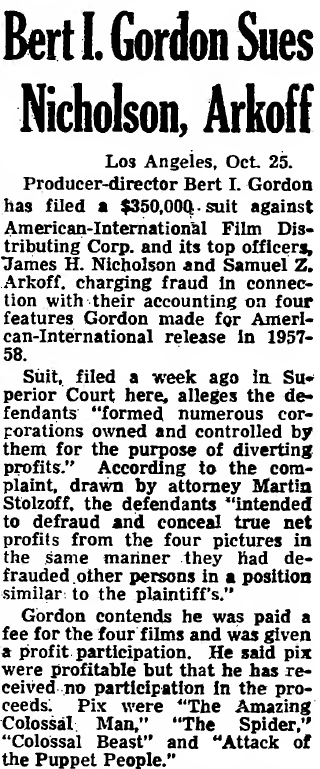
One example of what would have been more interesting to include, in 1960 Bert sued American International Pictures (AIP) and its top officers James H. Nicholson and Samuel Z. Arkoff for $350,000. How was that court case resolved? Did Bert win any of the money he sought? I don’t know and the suit was not mentioned in his book. He did work for AIP again to make 1976’s “The Food of the Gods” and 1977’s “Empire of the Ants” (starring Joan Collins). Apparently, they reached some type of settlement.
There were surprising omissions concerning his private life as well. Most significantly was the complete lack of any reference to Bert’s first wife Flora Lang. They were married from 1945 until 1979 and had three daughters together: Carol, Patricia, and Susan (who became an actress). Flora was with Bert before he moved to Hollywood and throughout his early cinematic career. Furthermore, their partnership was not just a romantic pairing. Flora was also involved in the production of the most famous and financially successful movies made by her husband during the 1950s, 1960s, and 1970s. She worked in costumes and make-up, as an assistant director, in production, and in special effects and visual effects.
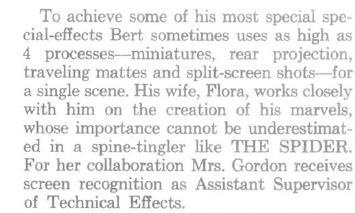
Of note, historian and researcher Tom Weaver interviewed Gloria Talbott, she played the former girlfriend of the titular monster in The Cyclops. Gloria claimed that Bert treated his wife poorly, as if she was “the help.” If true that ill treatment presumably contributed to the divorce decades later.

Bert did briefly mentioned his second wife, Eva Marie Marklstorfer, and stated that she was the love of his life. That was a nice sentiment. It was not very informative, but sweet. Although, Bert spelled her name as “Evi” (on page 129), but Variety’s obituary for Bert spelled her first name as “Eva.” Maybe Evi was an informal spelling or a pet name? Alternatively, did the man misspell his own wife’s name? (Dude, fix that before hitting the print button!)
Bert specifically refused to discuss his first wife Flora and their daughter Susan when he was interviewed by David Del Valle for Video Watchdog and when he was interviewed by Marty McKee during the Insect Fear Film Festival. He did mention daughter Susan in his autobiography, but kept silent about his first wife Flora.
If an unaware reader bought this book thinking it would give them a comprehensive overview of the man’s life (the point of biographies) then they would be completely unaware that Flora ever existed!
That’s a shame as she was involved in many of Bert’s most well-known films. IMDb credits Flora with many films including, but not limited to, The Cyclops, War of the Colossal Beast, Attack of the Puppet People, Village of the Giants, and The Food of the Gods. After their divorce Flora worked on many television shows, including as a unit production manager for the 1980s hit Dynasty.
Based on his reluctance to discuss Flora, it seems likely that there was lingering animosity which was never resolved after their divorce. It’s understandable if he was reluctant because of an embarrassing indiscretion, like an affair. If so, there’s no need to provide all the sordid details. A simple admission, Bert could have wrote “I made a mistake,” would have sufficed. Whatever led to their split was probably not that dramatic. All the same, it was unfortunate that he couldn’t muster the courage to mention someone who by all reports significantly contributed to his cinematic career and with whom he had three children.
As for his daughter Susan Gordon, a 2006 interview with her was published in Scarlet Street No. 55, but made no mention of problems with her father. In fact, she claimed that they had “… a very good father/daughter relationship …” Therefore it is unknown why Bert refused to discuss Susan in multiple interviews.
Additionally, according to the New York Times, Bert served in the United States Army Air Forces during World War II. Yet, there was no mention of his wartime service in Bert’s book. Even if his time was spent doing mundane tasks, perhaps he just peeled potatoes for a field kitchen, it still should have been mentioned.

Ideally, an autobiography or biography would provide basic details about its subject. Details like their level of education, if they were ever married and if so how many times, who they were married to, did they have children, did they ever serve in the military, etc. The minimal facts which are included in an “Infobox” at Wikipedia.
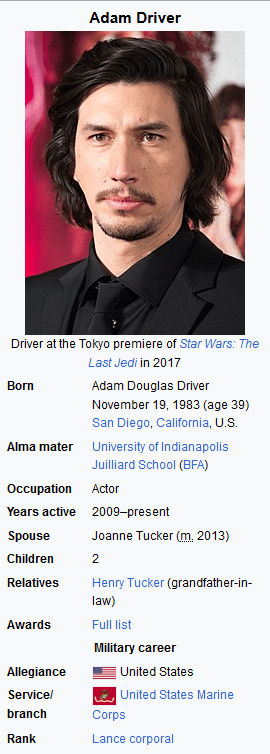
For an example of the key biographical details typically included in Wikipedia Infobox, see this one on the left taken from the entry for actor Adam Driver, famous for his role as the villainous Kylo Ren in the Star Wars sequel trilogy. If Wikipedia can cover this data in a small infobox then a writer can also include that in a book which consists of 274 pages.
However, after finishing “The Amazing Colossal Worlds of Mr. B.I.G.” a reader would be completely unaware that Bert had ever been in the American military. Presumably, there was at least one noteworthy event that occurred during his wartime service. Something that would have been of interest and could have improved this book.
Maybe Bert experienced deadly combat and understandably felt great fear as an aircrew member on a bomber that was repeatedly hit by anti-aircraft artillery. Alternatively, it could have been that he was a dental technician who never left the United States and thus felt guilty due to his lack of combat experience.
Maybe he took shelter inside a concrete bunker on Kandahar Air Field after a mortar attack. While waiting for the all-clear, he sat next to a few Bulgarian soldiers who complained about living in tents near the base’s lake of sewage (a.k.a. the shit pond) in which waste produced by tens of thousands of portable toilets was deposited. (Whoops, my bad! That was my own military experience.) My point is Bert presumably had at least one interesting anecdote from his time in uniform during what was the most significant conflict, World War II, of the modern era.
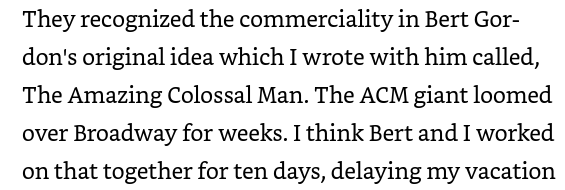
Additionally, Bert failed to credit someone who worked on one of his films. Mark Hanna co-wrote The Amazing Colossal Man (ACM) alongside Bert. (SIDE NOTE: After ACM, Mark wrote “Attack of the 50 Foot Woman” (AOTFFW) for Bernard Woolner. Bert wasn’t involved with AOTFFW.) However, Bert merely reported that he moved into an American International Pictures office and began working on the screenplay. Not once did Bert mention Mark’s name.
In contrast, Mark was willing to give credit where credit’s due. He did not claim to be solely responsible for writing ACM. Instead, Mark wrote that he worked with Bert in Mark’s own autobiography.
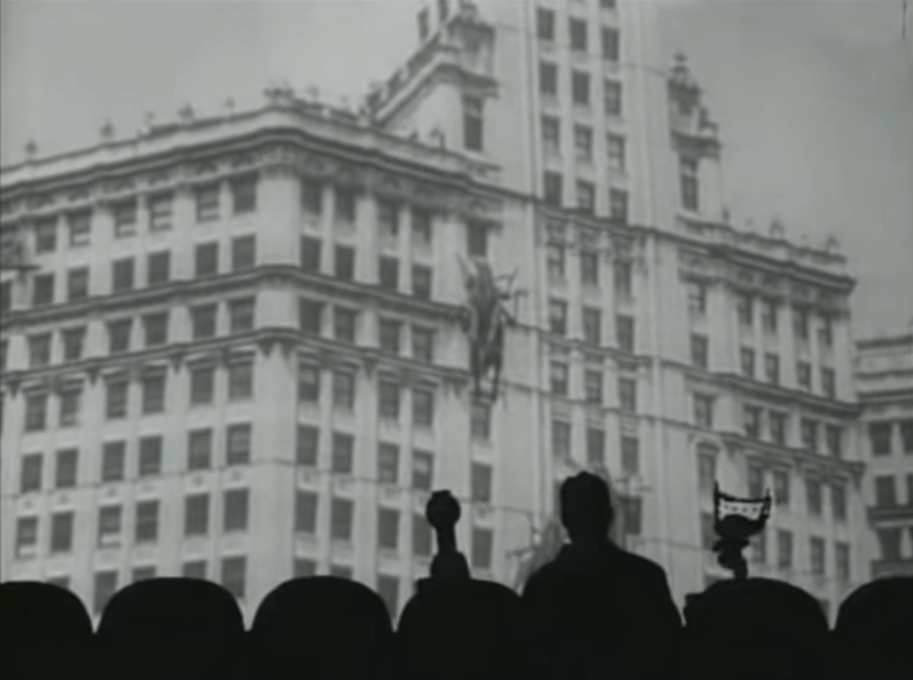
Bert also demonstrated a lack of self-awareness. Discussing 1957’s “Beginning of the End,” Bert outlined his process for creating the special effect of giant grasshoppers climbing the Wrigley Building in Chicago. However, he never acknowledged that filming live insects on a post card did not make a convincing effect. It looked fake, to put it mildly.
Bert’s book also looked sloppy. For instance, Bert thanked the cover artist, Lorraine Bush, in the Acknowledgments, but spelled her given name as both “Lorainne” and “Lorraine” within the space of a single paragraph (on page 262). If he was truly grateful then he should have made the effort to spell her first name correctly!
He also reminisced about his experiences at carnivals just outside his home town’s city limits. At the age of 9 (!) he was able to pay two dollars to enter a special tent and see adult women completely naked. Apparently, the carnival barkers had no issue with letting young boys into the show. However, the worst part was when Bert told the story of seeing a woman pulled into the bushes by a carnival worker and raped while a crowd of people did nothing to help her.
So, if anyone ever waxes nostalgically about the “good old days” in America you can point them to Bert’s book. Ask them if the good old days were 1930s Wisconsin where little kids could see women naked inside a sideshow tent and where women were raped while bystanders made zero effort to save them.
To close out my assessment of Bert’s autobiography, there was some value in it. The first two chapters outlined his beginnings and thus gave background to how someone from the Midwest was able to break into Hollywood. However, I do not recommend purchasing the autobiography; it’s not worth your hard-earned dollars. I intend to donate my copy to Taedis so you may see it at the next SizeCon in the Size Library and Museum!
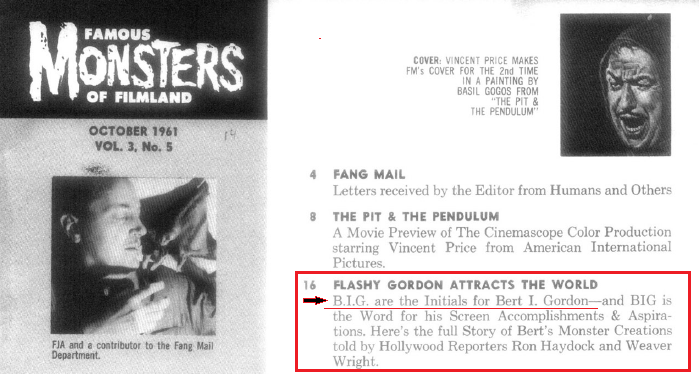
Bert I. Gordon managed to carve out a place for himself in cinematic history making cheap sci-fi flicks about giants and occasionally puppet people who despite the title do not actually attack. He never earned mainstream critical success or the blockbuster financial returns he craved.
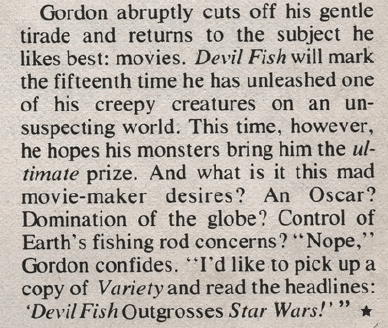
Nonetheless, Bert made a fair amount of money, enough to afford a “… glass-enclosed, well-appointed Southern California home with mandatory pool …” (as reported by David Del Valle of Video Watchdog). That’s not half bad for a self-taught movie maker.
Most of Bert’s films are not worth watching as better examples have been produced over the years. There are classic giant monster movies (not made by Bert) which are still enjoyable for modern audiences. “Godzilla,” “Rodan,” “The Beast from 20,000 Fathoms,” “The Blob,” and “Them!” are all worth a watch. Out of Bert’s entire filmography, the best in my opinion are “Attack of the Puppet People” and “Village of the Giants.”
That’s it for today folks. Next week’s review will cover videos from a creator which has not been discussed before at There She Grows. Until then, keep growing!
This article was written by SolomonG and is protected under Fair Use copyright law.
All Rights Reserved.
 There She Grows
According to Vicki London, on the production of Village of the Giants Gordon asked the actors playing the giantess characters to take off their tops so he could see who had the largest breasts in order to determine who would be featured in the poster. London and Tisha Sterling refused while Joy Harmon and Gail Gilmore complied. Harmon got the spotlight role, and London’s role in the film was cut back.
LikeLiked by 1 person
Can you share the source for that interview? I plan to revisit VoTG later this year.
LikeLike
My only source is IMDb. I’d prefer to have additional sources.
LikeLiked by 1 person
Yeah, me too. The VoTG post is several months away so there’s time to research.
LikeLiked by 1 person
i have a commsion for you
LikeLike
Sorry, but I don’t have the time to do a commission right now. I’m leaving soon for a month-long trip to the States and have several things to do beforehand.
LikeLike
ok meybe some tiime in the future then
LikeLiked by 1 person
i have a commsion for you
LikeLike