
Good morning everyone,
We are sticking with novels written in the 2010s with today’s subject, “The Thunderbird Project” by Rebecca Harwell. The Thunderbird Project released in mid-August 2013. According to a Tri States Public Radio article by Scott Stuntz, Harwell was a 19-year old Knox College sophomore when Bedlam Press published the superhero suspense story, her debut novel. That was an impressively early start!

The Thunderbird Project was a FBI-ran team of superheroes which officially disbanded four years before the events of this novel. Dr. Alan Wanze, director of Locus, Inc. a “pioneer in evolutionary biology,” conducted illegal genetic experiments on a number of fetuses. The resulting babies were sent out to be adopted by couples around the United States. (SIDE NOTE: Pretty trusting to spend significant money and time developing metahumans then sending them out for randos to raise them.) The FBI intervened after the babies had grown up and developed extraordinary abilities and the responsible scientists were jailed for crimes against humanity. (LEGAL QUESTION: Are “crimes against humanity” an actual chargeable offense in American criminal courts?)
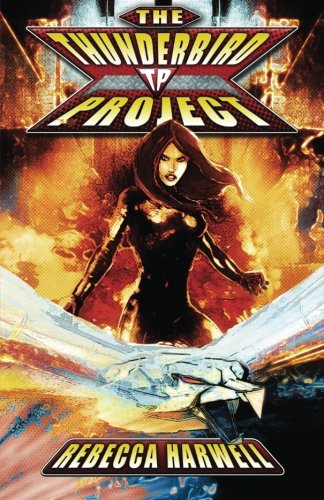
After Thunderbird Project disbanded the super-powered members built new lives by pretending to be normal people, to greater and lesser success, when a secret group targeted them for assassination! Among the former members was an 18-foot tall woman code-named Jupiter. She was the closest thing to a main character and giantess fans will be happy to learn that she got some development. Harwell provided a family history and background for Jupiter (a.k.a. Jupe, real name Elizabeth Brown). Although, giantess fans may not like the ending. Back cover of this book has a line that reads “You don’t get a ‘Happily ever after’ when everyone considers you a freak” so keep that in mind.
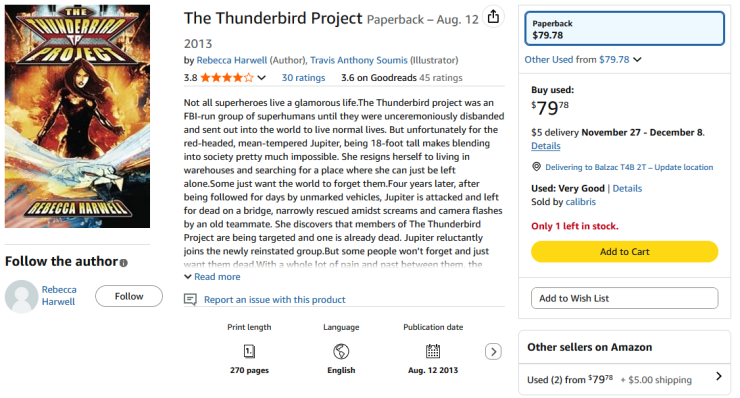
I appreciated the realism and portrayal of incredibly tough human beings that nonetheless can still be wounded or even die. Injuries included broken legs, cracked ribs, second- and third-degree burns, etc. The wounded needed time to recover from their injuries. Fight scenes felt impactful and visceral. Furthermore, scenes in which Jupiter threatened people were effective. When she threatened to rip a man in half it was believable.
Members of The Thunderbird Project each had unique superpowers. Along with the super-tall Jupiter, one was a pyrokinetic (able to manipulate fire), another could control machines, one man could transform rubble (or presumably anything) into explosives, one woman could turn her body intangible, one woman could control people with super-hypnotism, and the last man had super-healing. Furthermore, they all had enhanced immune systems, efficient digestive systems enabling them to survive on only one meal per week, more stamina, etc. Jupiter got the most description, but others got some as well. Although Abbott, the man with super-healing, was already dead before the narrative started.
As for negatives, the biggest mark against this story is that it feels like “grimdark” media, such as Games Workshop’s Warhammer 40,000 miniature wargame franchise or Todd McFarlane’s Spawn comic, born in the 1980s and 1990s. Shadowy authority figures in the American government were hellbent on hurting the members of The Thunderbird Project. Nothing wrong if gritty stories are what some people are looking for, but after awhile I was in need of something good to happen to the main character.
When the FBI disbanded Thunderbird Project its genetically enhanced individuals were scattered across the United States. Everyone, except Jupiter, was able to blend in with normal society. Jupiter was permanently gigantic, unable to shrink to a normal size. Her adopted parents disowned Jupiter after she grew way taller than average. She had no support. So, she had a myriad of disadvantages such as being visibly and unmistakably non-human thus the government forbid her to interact with the public. Jupiter lived in alleys and abandoned warehouses moving around only at night. She was isolated and literally spoke to zero (!) people during the four years (!!) when The Thunderbird Project was disbanded. Even after rejoining her old acquaintances Jupiter was unable to attend a team member’s funeral because it was held in public. She could not even sit down like a normal person because couches and seats were insufficient to hold her weight so she required a specially-made metal chair with extra steel reinforcement (by the way, that special chair eventually broke). Scorned by her parents (who were obsessed with appearances repeating “What will the neighbors think?”) and ignored by the only people she could consider friends Jupiter got the worst of everything.
Maybe I am too Pollyanna, but an uninterrupted stretch of unfortunate events can turn into a drag after awhile. Like listening to a friend tell you about how he is getting divorced, his kids will not speak to him, doctor says the weird lump on his arm might be cancerous, his dog has leukemia, etc. In this narrative bad things happened to people who did not deserve such treatment. Eventually, the good guys succeeded at great cost, but I was hoping Jupiter would get a reward of some sort after a litany of soul-crushing struggles. That did not happen. Ultimately, she was a selfless champion despite the fact that the world (including her fellow Thunderbird team members) treated her like nothing more than a powerful weapon only good for hitting stuff.
Bottom line, I do not recommend The Thunderbird Project at current prices. However, if grimdark fans want a physical copy and can find it reasonably priced, say for less than $5, than it is worth their purchase. Alternatively, folks can read it for free at the Internet Archive. I plan to donate my copy to Taedis’s Size Library and Museum (SLaM).
That is it for now folks. Until next time, keep growing!
This review was written by SolomonG and is protected under Fair Use copyright law.
All Rights Reserved.


P12 sandpaper wasn’t as abrasive as the protagonist & I Totally wasn’t upset by her fate.
I don’t see how she existed in Any kind of stealthy manner for her homeless arc & she should have been discovered quite quickly.
Personally, if I were a colonel in the USMC I would have offered Missus XL Grumpypants a spot in an invasion force. Room, Board & the chance to take her frustrations out on Uncle Sam’s plethora of foes.
No God, No Masters, No Chill. Thunderbird Project was a lousy, pointless book.
LikeLiked by 1 person
Yeah, I can see why you thought the protagonist was unlikable. Although, if someone was to take away our families, friends, jobs, and homes then that would make any of us equally unlikable.
I also found it hard to believe that an 18 ft tall woman went unnoticed for years. The FBI seemed beyond idiotic to think that she would stay hidden without any support.
LikeLiked by 1 person
“You don’t get a ‘Happily ever after’ when everyone considers you a freak“
I can’t think of a more revealing or more repellent bit of copy to put on either cover of your book.
I, too, find four years of solitude for this titaness to be implausible, as well as the universal reaction of abhorrence to her size. I think the author has some issues he needs to work on in therapy.
LikeLiked by 1 person
That “universal reaction of abhorrence to her size” reminds me of the Amazing Stories episode in which Jon Cryer was repulsed by a 10-foot tall statuesque blonde that was utterly devoted to him. As if his character thought:
“Oh no, an unusually tall gorgeous babe is interested in me! How horrible. ”
I rolled my eyes so hard…
https://thereshegrows.net/2022/02/17/mainstream-fare-7-amazing-stories-s2e2-miscalculation-from-1986/
LikeLiked by 1 person
A broadly termed US bill was proposed in 2010, the Crimes Against Humanity Act (S.1346) that attempted to bundle a variety of atrocities against civilians in a systematic attack, but it never got past the introduction stage. The offense has been included in several international criminal tribunals. See Article 7 of the Rome Statute for the ICC.
https://www.ohchr.org/en/instruments-mechanisms/instruments/rome-statute-international-criminal-court#article-7
LikeLiked by 1 person
That matches what I was thinking insomuch as crimes against humanity is a chargeable offense in the ICC, but not currently in American courts. I do not know what law would be broken by genetically modifying infants, but it sure feels like it should be illegal! One can only imagine the uproar if those infants develop inhuman traits; ergo, if they turn into werewolves or sprout wings. Even without visible deformities the giantess’s parents reacted as if she had turned into a monster.
LikeLiked by 1 person